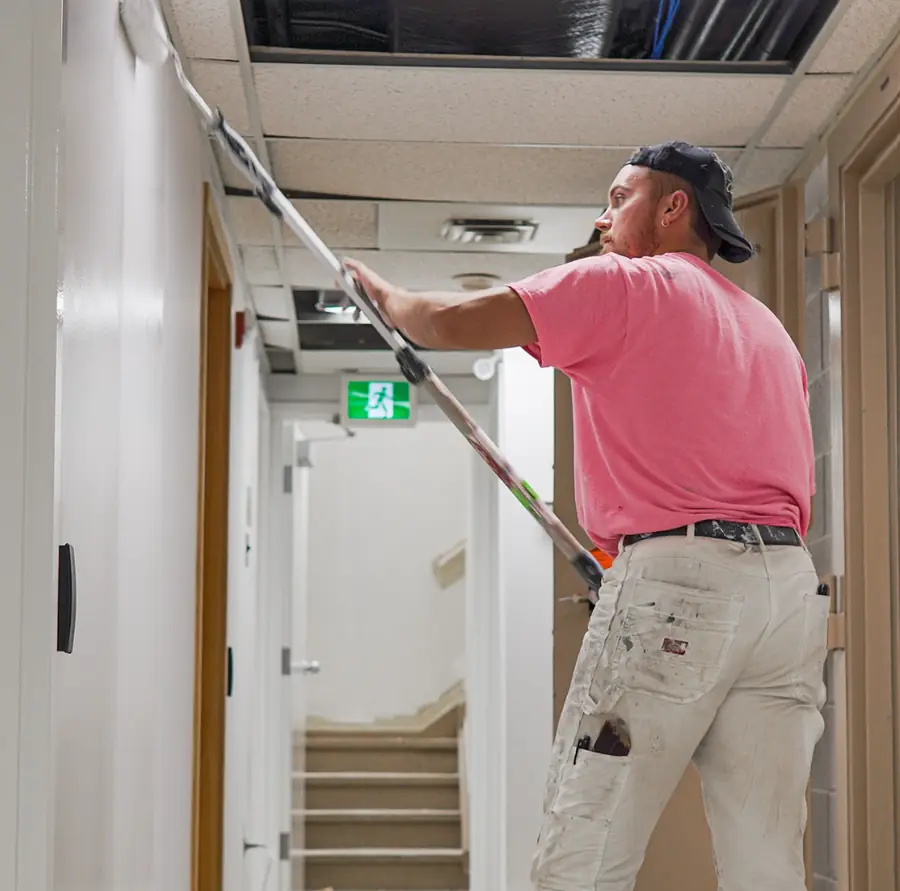
Winter is the best time for interior painting in Winnipeg. From November through March contractors have open calendars, you can usually pick your start date instead of waiting six to eight weeks, and indoor conditions stay stable all day. The trade-offs are real: Winnipeg's winter air is brutally dry, which shortens open time and punishes sloppy technique, and you cannot air out a room by opening a window at -30 °C. Both are solvable once you know they're coming. Here's how we work through a Winnipeg winter.
The off-season advantage: you get the crew you actually want
Between May and September, most of this city's painting capacity is outdoors. Exterior painting has a short, weather-dependent window in Manitoba, and every crew in Winnipeg is chasing it before the first hard frost.
That's why an interior estimate booked in June often comes back with a start date in August, while the same request in January is usually scheduled inside two weeks, with the experienced lead hands rather than the summer overflow crew.
It's also the time to plan seasonally: handle the interior now, and put deck staining once spring arrives on the calendar for May.
What -30 °C outside does to the air inside your house
Cold air holds very little moisture. Heat it to 21 °C in a forced-air furnace and the relative humidity in a typical Winnipeg home drops below 20%, sometimes into the low teens during a cold snap. That's drier than most desert climates.
Dry air pulls water out of latex fast, which means a much shorter open time: the film starts setting before you've finished the wall. On a finished surface that shows up as:
- Lap marks where a roller passed over paint that had already begun to skin over
- Poor levelling: roller stipple and brush ridges that would normally flow out stay locked in
- Flashing: dull or glossy patches, most visible on sidewalls in raking light
The fixes are technique, not product. Work in smaller sections, keep a wet edge, and box your paint so colour and viscosity match across cans. A flow extender buys back open time. Don't overwork a section. Going back over paint that's already setting causes most of the damage.
Check the surface temperature, not the thermostat. A wall behind a north-facing window can sit 8–10 °C colder than room air, and paint won't coalesce properly on a cold surface.
Dry air is an advantage for one job: sprayed finishes flash off fast and pick up less dust, which is why winter is our busiest season for cabinet refinishing. The cabinet refinishing cost calculator gives you a range before you book.
Season-by-season interior painting conditions in Winnipeg
| Season | Availability | Indoor RH | Dry & cure behaviour | Ventilation |
|---|---|---|---|---|
| Winter (Nov–Mar) | Excellent, 1–2 weeks out | 15–25% | Fast surface dry, short open time; full cure 2–4 weeks | HRV and exhaust fans only |
| Spring (Apr–May) | Good, tightening in May | 25–40% | Near ideal; watch cold snaps | Windows on mild days |
| Summer (Jun–Aug) | Poor, 4–8 week waits | 45–60%+ | Slower dry; humidity delays recoat | Windows open, dust gets in |
| Fall (Sep–Oct) | Fair after Thanksgiving | 30–45% | Ideal, but the shortest window | Windows most days |
That humidity spread is the biggest variable in how interior paint behaves here; Environment and Climate Change Canada publishes the Winnipeg climate normals if you want the underlying numbers.
Ventilation when you can't open a window for four months
For four months of the year cross-ventilation isn't an option: you'd be dumping a room's worth of heat outside and risking frozen pipes on an exterior wall.
That makes product selection more important here than almost anywhere in Canada. Low-VOC and zero-VOC acrylics aren't a marketing upgrade in Winnipeg; they're what makes painting an occupied house in January reasonable. In winter we won't put solvent-based alkyds or lacquers into an occupied space at all.
How to air out a room safely at -25 °C:
- Run the HRV on boost. Most Winnipeg homes built since the mid-1990s have a heat recovery ventilator. It exchanges air without throwing away the heat.
- Use the exhaust fans you have. Leave bathroom and kitchen fans running through the workday and for 24 hours after.
- Close the room off. Seal the doorway with plastic and vent that one room rather than pushing fumes through the house.
- Short window bursts, not open windows. Five minutes of a cracked window with a box fan blowing outward moves more air than an hour of a window open a centimetre.
Never let paint freeze: storing and transporting latex below 0 °C
Latex is water-based and freezes at roughly -1 °C. One freeze-thaw cycle may be survivable; several will destroy the can.
- Nothing sits in a vehicle overnight. A truck box at -28 °C will freeze a five-gallon pail solid.
- An unheated garage is not storage. It freezes, thaws in April, and is useless by the time you need a touch-up.
- Let delivered paint acclimate at room temperature for 24 hours before it's opened.
- Frozen paint doesn't always look frozen. Thawed latex can appear fine and then fail on the wall: grainy texture, stringy roll-off, poor adhesion. If it won't stir back smooth, it's done.
- Keep leftovers in the basement, sealed, upright and off the concrete floor.
Prep problems specific to Manitoba homes
Winnipeg sits on Red River clay, which expands and contracts dramatically with moisture. Combined with a 60-degree annual temperature swing, it produces a specific set of interior defects in homes of every age.
Nail pops and drywall cracks. Seasonal foundation movement pushes fasteners out and opens seams, usually at the corners of door and window openings. Skimming over a nail pop without resetting the fastener guarantees it returns next winter. Patching, texture matching and the drywall repair that has to happen before paint is its own scope of work.
Condensation staining. Dark patches and mould around window frames and on exterior-wall corners are a moisture problem first. That gets cleaned and treated before anything is painted over it, or the stain returns.
Ice-dam ceiling stains. A brown ring on a bedroom ceiling means water tracked in under the shingles. Latex primer won't hold that back: the stain bleeds through. It needs a shellac-based stain-blocking primer spot-applied first, then the ceiling coated.
Older housing stock: River Heights, Wolseley, Crescentwood and St. Boniface
Winnipeg's character neighbourhoods each bring their own surprises.
Plaster and lath. The 1910s and 1920s homes we work in throughout River Heights are plaster over wood lath, not drywall. Cracks recur along the same lines with seasonal movement, so they get bridged with mesh tape and a setting compound rather than filled with lightweight filler.
Calcimine ceilings. Calcimine is a chalk-and-glue distemper used on ceilings into the 1950s. Roll latex over it and the new paint delaminates in sheets within months. It has to be washed off or locked down with an oil-based sealer, and you only find out by testing (common enough in the character homes around Wolseley that we test every original ceiling before quoting).
Lead paint. Homes built before 1960 are the highest risk, and lead was still present in some consumer paints into the late 1970s. That doesn't mean don't paint: it means don't dry-sand. Wet-sanding, containment and HEPA vacuuming, with no open sanding in an occupied house. Health Canada's guidance on lead and human health covers what matters for homeowners.
Choosing colour when the sun sets at 4:30
In late December Winnipeg gets about eight hours of daylight and the sun never climbs far above the horizon. A colour chosen in January reads differently in June.
North-facing rooms get no direct sun and shift cool: greys go blue, warm whites go flat, beiges turn grey. South-facing rooms get long, low, warm winter light that pushes everything toward yellow.
Test properly. Paint two coats on a large sample board (not a chip) and move it around the room. Look at it at 10 a.m., 3 p.m. and 8 p.m. under the lamps you actually use. LED bulbs vary enormously in colour temperature, and half of a Winnipeg winter evening is spent under them.
If you'd rather start from something finished, our recent Winnipeg projects show how these colours land in real rooms.
Booking interior painting in Winnipeg for the winter season
Most of this is manageable as a homeowner with time and patience for prep. What isn't worth taking on yourself: calcimine ceilings, suspected lead, recurring plaster cracks, and any ceiling with a water stain. Those are the jobs where getting it wrong means doing the whole room twice.
If you've reached that point, our professional interior painting in Winnipeg covers walls, ceilings, trim and doors with full prep, protection and a room-by-room walkthrough before we call it finished.
Frequently asked questions
Can you paint inside during a Winnipeg winter?
Yes, and it’s the best season to do it. Interior painting is unaffected by outdoor temperature as long as the house is heated and the paint is stored properly. The two things that change are open time, because the indoor air is extremely dry, and ventilation, which has to be mechanical.
How long does interior paint take to dry in winter?
Faster than you’d expect on the surface, no faster underneath. At 15–25% relative humidity most latex is dry to the touch within an hour and ready to recoat in about four. Full cure still takes two to four weeks.
Will the paint smell be worse with the windows closed?
Not with the right product. Modern zero-VOC and low-VOC acrylics have very little odour, and most clients are comfortable in the room the same day. What you cannot do in winter is run solvent-based alkyds or lacquers in an occupied house: the smell has nowhere to go.
Is it cheaper to paint the interior in winter?
Scheduling is easier, quotes come back faster, and some contractors price off-season work more competitively. Worth asking directly. The bigger saving is indirect: an unrushed crew with time to prep properly produces work you don’t repeat in three years.
Can I store leftover paint in my garage over the winter?
No. An unheated Winnipeg garage drops well below freezing, and latex that’s frozen and thawed often can’t be brought back. Store sealed cans in the basement, upright and off the floor.
Get a free estimate
Winter dates fill well before the January cold snap, so get it on the calendar now.
Call or text (204) 590-9412, email mernerkrowetzpainting@gmail.com, or book a free painting estimate online.
We serve Winnipeg and surrounding neighbourhoods including River Heights, St. Vital, St. Boniface, Tuxedo, Charleswood and Transcona. See every neighbourhood we cover across the city.
Recent job-site photos and reels are on Instagram at @mernerspaintingandcontracting.